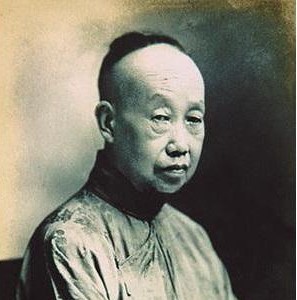
Wu Changshuo (吴昌硕, 1844 - 1927) was a prominent Chinese calligrapher, seal carver, painter, and poet in the late Qing dynasty. He was born into a scholarly family in Zhejiang. During the Taiping Rebellion toward the end of the Qing dynasty, he lost most of his family members and his newly wedded wife. After being displaced for 5 years, he finally returned to his hometown and immersed himself in seal carving, poetry, and calligraphy. Later, he lived between Suzhou and Shanghai by selling his calligraphic works and taking up low-ranking official posts.
He had an interest in seal carving and calligraphy from a young age and learned extensively from the Zhe school and also the ancient Qin and Han styles. Later, he developed his unique "Wu style" in seal carving. His seals were either extremely elegant or intrepidly bold.
He only started painting in his 30s at the advice of his friend. Thanks to his solid foundation in calligraphy and seal carving, he was able to apply epigraphy (antique inscriptions in metal and stone) to painting and became an accomplished artist in his later years. His paintings were often done with heavy and forceful brushstrokes with pure contrasting colors. He was the leader of the Shanghai school and a highly influential figure in xieyi (idea sketching) bird-and-flower painting.


