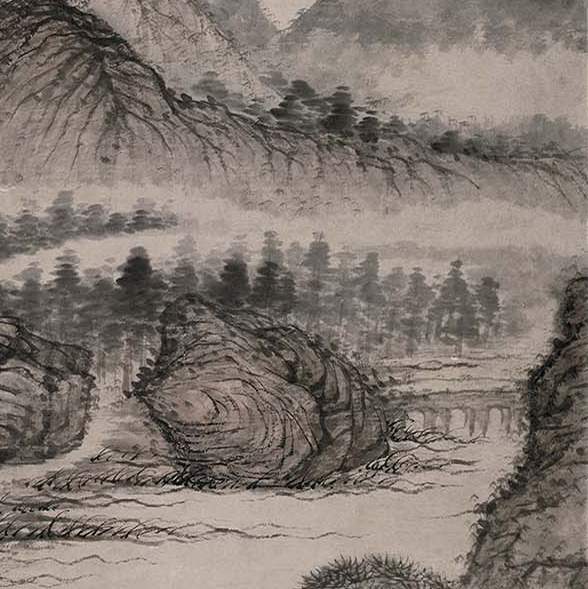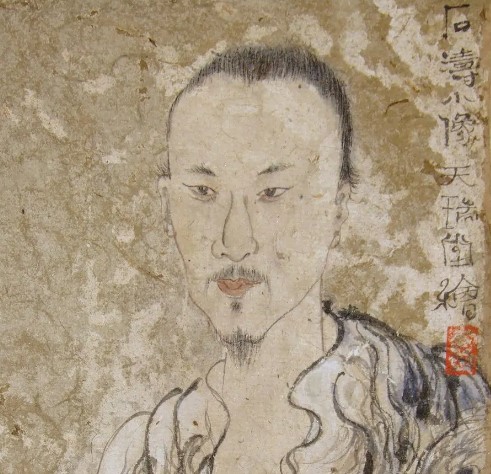
Shi Tao (石涛 in Chinese, 1642-1708) was a descendant of the Ming dynasty's royal family. However, when he was born in 1642 in Quanzhou, Guangxi province, the Ming dynasty had only two years left as the ruling regime. His father was executed due to political rivalry in 1646, and fearing prosecution, he was cared for by a family servant and escaped to Quanzhou. There, he shaved his head to become a Buddhist monk and adopted the name Shi Tao.
Shi Tao led a wandering life, traveling extensively in the first part of his life. When Emperor Kangxi of the Qing Dynasty conducted two southern tours in 1684 and 1689, Shi Tao was summoned twice by the emperor in Nanjing and Yangzhou. He presented his poems and paintings and referred to himself as a "servant monk." He later travelled to the capital city to befriend officials and nobility, creating artworks for them. However, he was unable to secure an official position and returned to Nanjing. He eventually settled in Yangzhou, making a living by selling his paintings. He also summarized his years of painting experience and insights into a book, "Philosophy of Painting" (画语录).
He excelled in both poetry and painting. He was known for painting landscapes, flowers, and plants, especially orchids and bamboo, as well as figures. His painting style underwent radical transformations throughout his career, from a bold and unrestrained approach to a more solid and steady one. He had a profound influence on the Yangzhou school of painting and on modern and contemporary Chinese painting.